
The NHBRC inspects all enrolled homes at key stages of construction. The objective of inspections is to protect housing consumers against poor workmanship during construction. In the situation where the inspector identifies a deviation from the NHBRC Home Building Manual, a non-compliance will be issued to the home builder.
The home builder will be given reasonable time frames within which to rectify the non-compliance. If the builder is unable or unwilling to rectify, the NHBRC will stop construction and institute its builder disciplinary process.
Inspection Process
THE NHBRC INSPECTOR
The NHBRC inspectors are appointed in terms of section 19, of the Housing Consumer Protection Measures Act, act 99 of 1995.
To assist home builders, through training and inspection, to achieve and to maintain satisfactory technical standards of home building;
The NHBRC inspector do quality assurance regarding the Home Builders compliance with the deemed to satisfy requirements specified in the SANS 10400 and 2001 series.
By implication, the process of quality assurance seeks to ensure that the Home Builder complies with the technical documentation that was prepared to construct the residential unit.
The NHBRC quality assurance inspectors therefor play a crucial role in business by ensuring that housing products meet certain thresholds of acceptability during the following key stages of construction;
SUB-STUCTURE (Foundation)
SUPER-STRUCTURE
PRACTICAL COMPLETION
STORM WATER
The NHBRC inspector will do spot checks, rather than being on site 24/7 and are not appointed to do contract management or quality control on behalf of the Homeowner.
This function of quality control is for the Competent person (Engineer) who is appointed by the registered home builder in accordance with the Certificate of Appointment of Competent Person.
The Competent person is required to issue the Appendix D1 form (completion certificate) to certify that he has inspected the work during construction and have found the work to be in accordance with my design and or requirements.
The NHBRC may also require the home builder to notify the inspectorate of the above mentioned key stages of construction determined by the Council in enough time to allow the Council to arrange for inspection at its discretion.
An inspector may, for the purpose of inspecting a home during its construction, enter and inspect the premises constituting the site of the construction at any reasonable time.
For the purposes of an investigation, an inspector may—
(a) require the production of the drawings and specifications of a home or any part of a home, including plans approved by the local authority and plans and specifications prescribed in the Rules or the Home Building Manual, for inspection from the home builder and may require information from any person concerning any matter related to a home or any part of a home;
(b) be accompanied by any person employed or appointed by the Council who has special or expert knowledge of any matter in relation to a home or part of a home; and
(c) alone or in conjunction with any other person possessing special or expert knowledge, make any examination, test or enquiry that may be necessary to ensure compliance with the Home Building Manual.
The following elements to be confirmed by an Inspector;
- The NHBRC technical requirements for structural strength and stability;
1.1 A home and any structural element or component thereof must be designed and constructed to provide strength and stability for the lifetime of the structure in accordance with accepted standards of good practice at the time of design and construction.
1.2 Foundations must be designed and constructed to transmit loads from super- structures to soil horizons safely and without causing excessive movement or distress in the elements which they support. Foundations must be designed and constructed to resist differential displacement and to prevent the passage of moisture to the interior of the home.
1.3 Floors and stairways must be designed and constructed to safely carry their own dead loads in addition to any live loads which they are likely to be subjected, without undue deformation and distress.
1.4 Walls must be designed and constructed to safely withstand any load to which they are likely to be subjected without impairing weather tightness and without undue deformation and distress.
1.5 Roofs and their components must be designed and constructed to safely resist any forces to which they are likely to be subjected and without the roof construction becoming detached from its respective supporting structure.
- NHBRC technical requirements for materials
2.1 Materials used in the construction of homes must be sufficiently durable and of a suitable quality for the purpose for which they are to be used.
2.2 A home builder may be required by the Council to satisfy the Council that materials used or to be used by the home builder in the construction of a borne comply with the requirements relating to materials and the guidelines in relation thereto prescribed by the Council under section 12(1)(b) of the Act, or the requirements specified by a competent person in terms of section 12(2) of the Act, or the relevant requirements set out in an applicable Agrément certificate.
- NHBRC technical requirements for storm water disposal
3.1 Storm water disposal must be provided for the control and disposal of storm water in a manner which does not result in soil erosion or flooding which may detrimentally affect the structural integrity of the home; and reduces the risk of storm water entering the home.
For the NHBRC to satisfy itself that the above requirements have been met;
The Inspector will request the following;
- The D1 Form from the competent person.
- Foundation certificates, Roof certificates etc.
NHBRC Notice of Technical Non-Compliance
This Notice of Non-Compliance is issued in accordance with section 14(4) of the Housing Consumers Protection Measures Act.
The home builder must inform NHBRC in writing that he has rectified the notice of non-compliance as soon as possible and no later than the date by which compliance has been requested in the above notice. NHBRC reserve the right to inspect rectification work or any other matter.
Should this notice not be complied with or the home builder has failed to notify NHBRC of his compliance in writing within thirty days. NHBRC may take disciplinary action including the possible suspension of enrolments or the deregistration of the home builder in terms of section II of the Act.
In extreme situations, NHBRC reserves the right to suspend enrolments in terms of section 11(3) of the Act. The NHBRC may suspend or cancel in terms of section 14(4) of the Act, any enrolment on this home or homes should this Notice of Non-Compliance not be complied with.
The NHBRC reserves the right to inform the home owner and/or mortgage lending institution should the home builder fail to comply with this Notice or fail to inform NHBRC of his compliance in writing on or before the date stated on the document.
- The protocol that applies for doing inspections
We have inspectors stationed in each region who are available to conduct inspection on the enrolled homes;
Inspections is mostly a reactive process, and where homes that were enrolled and issued with an enrolment certificate are then escalated for inspection.
The inspector when receiving a request to do an inspection (system or manual BQIH), will confirm estimated date of commencement, and will then schedule a date for visiting the site. The Inspector will conduct a physically site visit on enrolled home within 5 working days. Where the work complies with the technical standards, the Inspector approves. Each structural item will be inspected and will be marked as per below:
0 = Non-Compliance
0.5 = Meets the minimum requirements
1 = Fully Compliant
NV = Not visible to HI/SHI
NA = Not applicable to this element of construction
The Inspector will issue the notice of non-compliance should the technical requirements not be met in terms of all the appropriate standards. A non-compliance signifies that part of the construction does not comply with requirements of SANS 10400, SANS 2001 series or the technical requirements stipulated in the HMB.
The inspector will record the date of compliance to ensure that an inspection is done to confirm compliance. Should the defaulting Home Builder fail to comply within stipulated time frames, the Notice of Non-Compliance will be forwarded to LCE to action.
In the case of compliant structures, the Inspector will schedule (diarise) his/her next visit to the site in line with their “Tour of Duty”. The Tour of Duty will confirm when next the inspector is in the area and will be doing follow-up inspections. Inspectors will then forthwith conduct quality assurance Inspections on work under-construction, work already completed or work previously rejected in line with the HBM and other regulatory requirements as set out in references above.
Need Information or Confused about Something ?
Ask a Question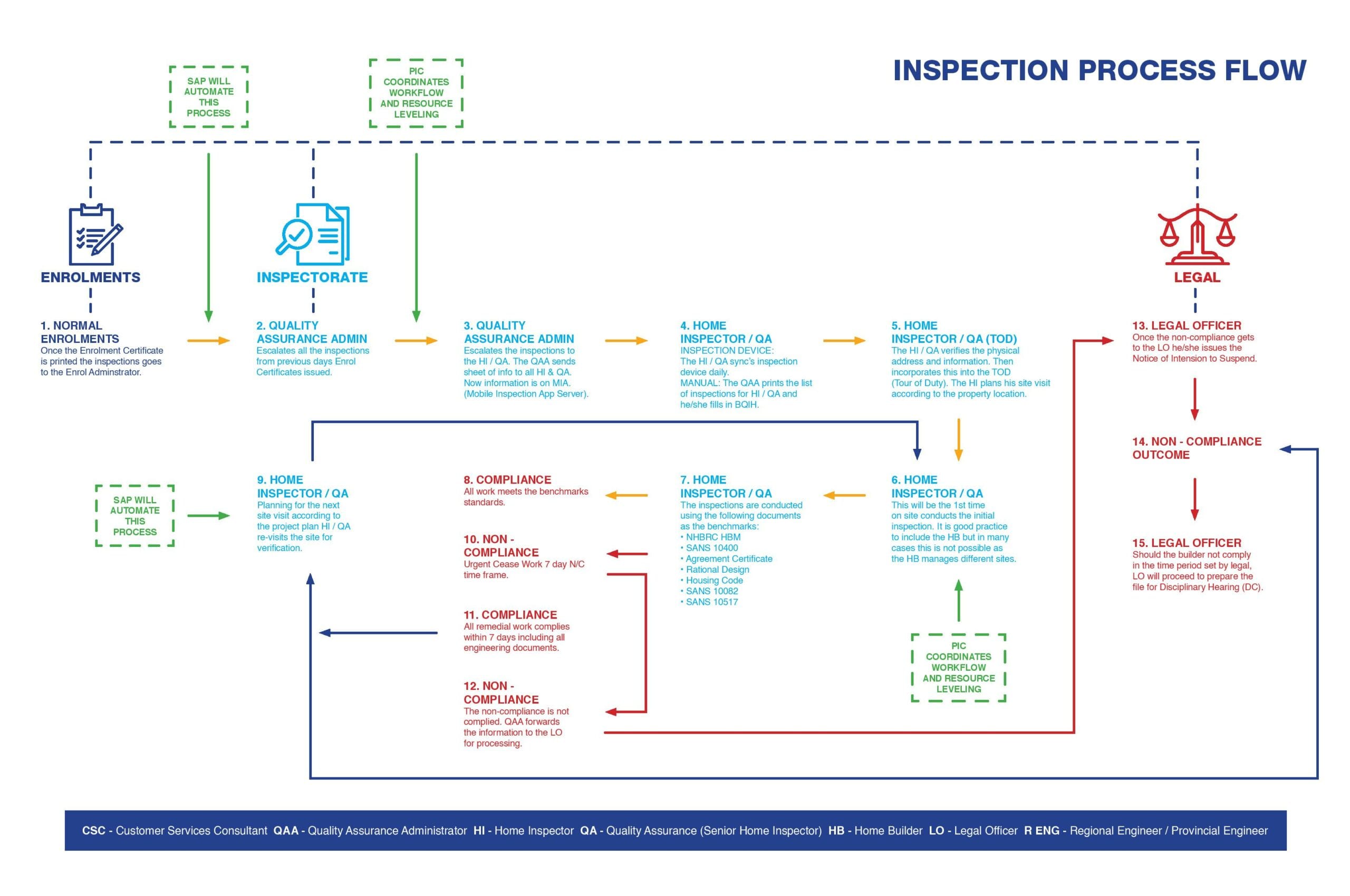
Sponsored Guide
Complete Guide to NSFAS Online Loan Application for South African Students (2025)
If you are a South African student looking to pursue higher education but are facing financial difficulties, the National Student Financial Aid Scheme (NSFAS) is one of the most accessible funding options available. NSFAS provides financial aid in the form of bursaries and loans to qualifying students at public universities and TVET colleges in South Africa.
This guide will walk you through everything you need to know about the NSFAS loan application process, from eligibility requirements to application steps and frequently asked questions.
📌 What is NSFAS?
The National Student Financial Aid Scheme (NSFAS) is a government-funded financial aid scheme aimed at helping students from low- and middle-income households to access tertiary education without the burden of upfront fees.
NSFAS offers both bursaries and income-contingent loans:
- Bursaries: For eligible students who meet academic and household income criteria (especially for TVET and university students).
- Loans: For students who do not meet all bursary criteria or who are pursuing postgraduate qualifications not funded under bursary schemes.
✅ Who Qualifies for an NSFAS Loan?
To qualify for an NSFAS loan (especially for postgraduate students or programs not funded under the bursary system), you must:
- Be a South African citizen.
- Be financially needy, with a household income of less than R350,000 per year.
- Have a valid South African ID.
- Be enrolled or accepted to study at a public university or TVET college.
- Not be funded through another bursary program that covers all expenses.
- Maintain satisfactory academic progress (returning students).
📚 Courses Funded by NSFAS
NSFAS primarily funds undergraduate qualifications, but certain postgraduate programs (e.g., PGCE, postgraduate diplomas in education, and professional courses like LLB) may be considered under the NSFAS loan scheme, not bursaries.
If you’re studying:
- Undergraduate degree or diploma: You are likely eligible for a full NSFAS bursary.
- Postgraduate study: You may qualify for a loan, depending on the course and funding availability.
📄 Required Documents for NSFAS Application
When applying, make sure you have the following documents scanned and ready:
- Certified copy of your South African ID or Smart Card.
- Parent(s) or guardian(s) ID documents.
- Proof of income (latest payslips, UIF, or affidavit if unemployed).
- Consent Form signed by your parent(s)/guardian(s) to allow NSFAS to verify income.
- Proof of registration or acceptance at a public institution.
- Academic transcripts (for continuing or postgraduate students).
🖥️ How to Apply for an NSFAS Loan Online
Step-by-Step NSFAS Online Application Process (2025)
-
Visit the NSFAS Website
Go to: https://www.nsfas.org.za
-
Create an Account
- Click on “MyNSFAS” and register your profile.
- You’ll need a valid email address and South African cellphone number.
- Choose a strong password and verify your account via email or SMS.
-
Login and Start the Application
- After registration, log in to your MyNSFAS account.
- Click on “Apply” to begin a new application.
-
Fill in Your Personal Details
- Input your ID number, name, surname, and other details exactly as they appear on your ID.
- Provide household income information and living arrangements.
-
Upload Required Documents
- Upload all supporting documents in PDF or JPEG format.
- Each document must be clear and under the size limit specified.
-
Submit Your Application
- Review your application for accuracy.
- Click “Submit” and wait for a confirmation message.
-
Track Your Application
- Log in regularly to check your application status.
- You will be notified via SMS and email at each stage of the process.
🗓️ Important NSFAS Dates (2025)
- Application Opening Date: September 1, 2025
- Application Deadline: January 31, 2026
- Appeals Period: February 2026 (if rejected)
- Disbursement: After registration and approval
Note: Dates are subject to change; always confirm on the official NSFAS website.
💸 What Does the NSFAS Loan Cover?
NSFAS funding typically includes:
- Tuition fees
- Registration fees
- Accommodation (if living away from home)
- Meals and transport
- Learning materials (e.g., textbooks)
For loans, repayment is only required once you start working and earn above a threshold (around R30,000 annually, but subject to change).
🔄 NSFAS Loan Repayment
Repayments are:
- Income-contingent – you only repay when you can afford to.
- Administered by DHET (Department of Higher Education and Training).
- Interest-bearing, but interest rates are low and favorable.
You can also apply for a partial loan conversion to a bursary if you perform well academically.
🔁 How to Appeal a Rejected NSFAS Application
If your application is rejected, you may submit an appeal via your MyNSFAS portal:
- Log into your MyNSFAS account.
- Click on “Track Funding Progress”.
- If rejected, click on “Submit Appeal”.
- Upload any missing or corrected documents.
- Provide a clear explanation or motivation.
📱 NSFAS Contact Information
- Website: https://www.nsfas.org.za
- Email: info@nsfas.org.za
- Toll-Free Number: 08000 67327 (Monday–Friday, 8 AM–5 PM)
- Twitter: @myNSFAS
- Facebook: NSFAS
📝 Final Tips Before Applying
- Apply early to avoid system overload near the deadline.
- Use your own email and cellphone number (do not use someone else’s).
- Double-check that all your documents are certified and legible.
- Keep a copy of your submission confirmation for reference.
By following this guide, you can confidently apply for NSFAS funding and move one step closer to achieving your academic and career dreams—without the burden of immediate financial pressure.