Latin Name
Order Diptera
Several Families and Species
What do gnats look like?
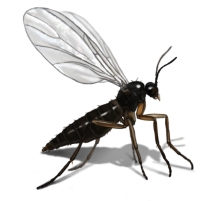
Gnats typically are small and long-legged insects. They often are weak fliers.
How Did I Get Gnats?
Moisture and organic material attract gnats. Some species prefer the soil of houseplants, while others seek out decomposing food debris in garbage disposals or on damaged and over-ripe fruit. Any wetness in the home or unsanitary habits could draw them indoors and once inside, gnats are able to take advantage of conditions that are favorable for continuous development and reproduction.
How Serious Are Gnats?
Gnats are a nuisance since they do not cause major damage to homes. However, gnats may threaten human health should they transport pathogens from their unsanitary development sites. Since fruit flies might contaminate food, and fungus gnats can harm potted plants, residents must eliminate potential breeding and developmental sites, since gnats will multiply and create an unclean environment.Bites & Disease
Females of some species, such as the black gnat or black fly, feed on blood. These gnats have been known to carry parasites and spread diseases to humans and livestock. Due to the spread of river blindness and other health concerns, numerous programs have been established throughout the world to control gnat populations.
How Do You Get Rid of Gnats?
What Orkin Does
The most effective control methods require positive identification of insects, which is best conducted with the assistance of a pest control professional.
The Orkin Man™ is trained to help manage gnats and flies. Since every home is different, the Orkin technician will design a unique program for your situation.
Keeping gnats or flies out of your home is an ongoing process, not a one-time treatment. Orkin’s exclusive A.I.M. solution is a continuing cycle of three critical steps—Assess, Implement and Monitor.
The Orkin Man™ can provide the right solution to keep gnats in their place…out of your home.
Signs of a Gnat Infestation
The main sign of gnats are the sightings of the adults as they fly about in the air.
Behavior, Diet & Habits
Gnat is the common name for many small, winged insects in the fly grouping. Contrary to popular belief, these tiny flying insects are not “babies,” they are adults. The tiny flying insects that many people call “gnats” could really be fruit flies or fungus gnats. There are many differences between fruit flies vs gnats.What Do They Eat?
Some species are excellent plant pollinators and feed on crop pests such as aphids and scales. Other gnats, such as the Hessian fly, are crop pests themselves. Depending on species, gnats can be biting or nonbiting and will feed on plants, other insects or blood.
Life Cycle
Mating in Swarms
For some species, males assemble in large mating swarms known as ghosts. These swarms occur most commonly at dusk in large fields and above streets.Eggs & Larvae
Depending on the species, gnat eggs are laid on land or water. Larvae may be immobile or capable of movement by way of rocks and water plants.Adults
Adults range in size but usually are no larger than 33 mm. The larval and adult stages of the gnat are considered both beneficial and detrimental.
Prevention Tips
Wet soil
The best control for fungus gnats is to identify any plants that have wet soil and let that soil dry completely before the next watering. This will kill the larval stages in the soil. The adult gnats can be removed with a vacuum cleaner from windows and from around the plants.
Watering plants only when they need water will help prevent fungus gnat infestations.Fruit
For most gnat populations, their food source must be located and corrected if possible. Fruit should not be exposed to open air. Keeping fruit in the refrigerator protects it from gnats and also prolongs the fruit’s period of ripeness.Traps
Electric fly exploders that electrocute individual gnats may help to control their populations outside but also kill many beneficial insects. Inside, insect traps that are plugged into electrical outlets work by emitting ultraviolet light sources. Flying insects are attracted to this light and are caught by the sticky surface of the trap when they approach.
Most of these methods address only individual, adult specimens. In order to properly treat an entire gnat infestation, including larvae, it is best to consult a pest control professional.
Need Information or Confused about Something ?
Ask a Question
Sponsored Guide
Complete Guide to NSFAS Online Loan Application for South African Students (2025)
If you are a South African student looking to pursue higher education but are facing financial difficulties, the National Student Financial Aid Scheme (NSFAS) is one of the most accessible funding options available. NSFAS provides financial aid in the form of bursaries and loans to qualifying students at public universities and TVET colleges in South Africa.
This guide will walk you through everything you need to know about the NSFAS loan application process, from eligibility requirements to application steps and frequently asked questions.
📌 What is NSFAS?
The National Student Financial Aid Scheme (NSFAS) is a government-funded financial aid scheme aimed at helping students from low- and middle-income households to access tertiary education without the burden of upfront fees.
NSFAS offers both bursaries and income-contingent loans:
- Bursaries: For eligible students who meet academic and household income criteria (especially for TVET and university students).
- Loans: For students who do not meet all bursary criteria or who are pursuing postgraduate qualifications not funded under bursary schemes.
✅ Who Qualifies for an NSFAS Loan?
To qualify for an NSFAS loan (especially for postgraduate students or programs not funded under the bursary system), you must:
- Be a South African citizen.
- Be financially needy, with a household income of less than R350,000 per year.
- Have a valid South African ID.
- Be enrolled or accepted to study at a public university or TVET college.
- Not be funded through another bursary program that covers all expenses.
- Maintain satisfactory academic progress (returning students).
📚 Courses Funded by NSFAS
NSFAS primarily funds undergraduate qualifications, but certain postgraduate programs (e.g., PGCE, postgraduate diplomas in education, and professional courses like LLB) may be considered under the NSFAS loan scheme, not bursaries.
If you’re studying:
- Undergraduate degree or diploma: You are likely eligible for a full NSFAS bursary.
- Postgraduate study: You may qualify for a loan, depending on the course and funding availability.
📄 Required Documents for NSFAS Application
When applying, make sure you have the following documents scanned and ready:
- Certified copy of your South African ID or Smart Card.
- Parent(s) or guardian(s) ID documents.
- Proof of income (latest payslips, UIF, or affidavit if unemployed).
- Consent Form signed by your parent(s)/guardian(s) to allow NSFAS to verify income.
- Proof of registration or acceptance at a public institution.
- Academic transcripts (for continuing or postgraduate students).
🖥️ How to Apply for an NSFAS Loan Online
Step-by-Step NSFAS Online Application Process (2025)
-
Visit the NSFAS Website
Go to: https://www.nsfas.org.za
-
Create an Account
- Click on “MyNSFAS” and register your profile.
- You’ll need a valid email address and South African cellphone number.
- Choose a strong password and verify your account via email or SMS.
-
Login and Start the Application
- After registration, log in to your MyNSFAS account.
- Click on “Apply” to begin a new application.
-
Fill in Your Personal Details
- Input your ID number, name, surname, and other details exactly as they appear on your ID.
- Provide household income information and living arrangements.
-
Upload Required Documents
- Upload all supporting documents in PDF or JPEG format.
- Each document must be clear and under the size limit specified.
-
Submit Your Application
- Review your application for accuracy.
- Click “Submit” and wait for a confirmation message.
-
Track Your Application
- Log in regularly to check your application status.
- You will be notified via SMS and email at each stage of the process.
🗓️ Important NSFAS Dates (2025)
- Application Opening Date: September 1, 2025
- Application Deadline: January 31, 2026
- Appeals Period: February 2026 (if rejected)
- Disbursement: After registration and approval
Note: Dates are subject to change; always confirm on the official NSFAS website.
💸 What Does the NSFAS Loan Cover?
NSFAS funding typically includes:
- Tuition fees
- Registration fees
- Accommodation (if living away from home)
- Meals and transport
- Learning materials (e.g., textbooks)
For loans, repayment is only required once you start working and earn above a threshold (around R30,000 annually, but subject to change).
🔄 NSFAS Loan Repayment
Repayments are:
- Income-contingent – you only repay when you can afford to.
- Administered by DHET (Department of Higher Education and Training).
- Interest-bearing, but interest rates are low and favorable.
You can also apply for a partial loan conversion to a bursary if you perform well academically.
🔁 How to Appeal a Rejected NSFAS Application
If your application is rejected, you may submit an appeal via your MyNSFAS portal:
- Log into your MyNSFAS account.
- Click on “Track Funding Progress”.
- If rejected, click on “Submit Appeal”.
- Upload any missing or corrected documents.
- Provide a clear explanation or motivation.
📱 NSFAS Contact Information
- Website: https://www.nsfas.org.za
- Email: info@nsfas.org.za
- Toll-Free Number: 08000 67327 (Monday–Friday, 8 AM–5 PM)
- Twitter: @myNSFAS
- Facebook: NSFAS
📝 Final Tips Before Applying
- Apply early to avoid system overload near the deadline.
- Use your own email and cellphone number (do not use someone else’s).
- Double-check that all your documents are certified and legible.
- Keep a copy of your submission confirmation for reference.
By following this guide, you can confidently apply for NSFAS funding and move one step closer to achieving your academic and career dreams—without the burden of immediate financial pressure.